Showing posts with label Asteroids. Show all posts

Thursday, June 27, 2013

Asteroids in our Future

I would recommend reading Paul Gilster's recent blog on the topic of asteroids in our future.
He has many other interesting blogs as well. 

This quote from his Charter - "In Centauri Dreams, Paul Gilster looks at peer-reviewed research on deep space exploration, with an eye toward interstellar possibilities."

Paul should help your looking up experience.
- LRK -

-------------------------------------------

Asteroids in our Future

by PAUL GILSTER on JUNE 27, 2013

NASA has released an Asteroid Initiative Request for Information on the issue of asteroid retrieval. It’s an interesting document both in its audience — the agency is making a point about soliciting comments not only from academics, scientists and engineers but the general public — but also because of the issues it explores. Being sought are ideas on how best to capture an asteroid, land an astronaut on one, and change its orbit, not necessarily in that order. The Los Angeles Times quotes NASA associate director Robert Lightfoot on the public component of NASA’s initiative:
“Too often, by the time we present a mission to the public, it has already been baked, and there’s not much we can change. This is your chance to present your ideas to us before the mission is baked.”
If you’re interested in contributing, move quickly, for the deadline for responses is July 18, with a workshop to follow in September.
snip
-------------------------------------------

After you read Paul Gilster's blog you may want to be entertained by listening to Phil Plait, if you haven't already done so.
- LRK -

-------------------------------------------
How Can We Defend Earth From Asteroids?
"When I go outside and it's clear? Yeah, I look up. It's a habit. It's something I wish more people did. You may seem something that will profoundly affect you."— Phil Plait
Gazing up at the night sky is simultaneously humbling and utterly thrilling. This hour, we'll hear from TED speakers who share an infectious sense of wonder and curiosity about our place in the universe and what lies beyond our skies.
snip
-------------------------------------------

Jeff Foust has some thoughts about the asteroid mission as well.
- LRK -

-------------------------------------------

Redirecting an asteroid mission
by Jeff Foust
Monday, June 24, 2013
 
When NASA released its fiscal year 2014 budget proposal two and a half months ago, a key element of it was a new “asteroid initiative” that called for $105 million for various asteroid search and technology development efforts. The centerpiece of that plan was a robotic mission to capture a small near Earth asteroid, no more than about ten meters across, and move it into cislunar space, where it could potentially be visited by astronauts on the first crewed Orion mission, slated for 2021 (see “To catch a planetoid”, The Space Review, April 22, 2013).

That proposed mission—called at the time the Asteroid Retrieval Mission, or ARM—raised more than a few eyebrows when NASA announced it in April. Some questioned the technical feasibility of the concept (which is based on a 2012 study by the Keck Institute for Space Studies at Caltech) while others wondered how useful it would be for science or human exploration. Now, with some members of Congress making moves to block the effort, NASA is showing signs of subtly shifting the focus of the proposed mission, and the overall initiative, more towards the less controversial role planetary defense.
snip
-------------------------------------------

Will continue to watch along with you.
Thanks for looking up with me.  
- LRK -
 
============================================

WHAT THE MIND CAN CONCEIVE, AND BELIEVE, IT WILL ACHIEVE - LRK -

============================================

Thursday, December 20, 2012

Asteroids and comets visited by spacecraft as of December 2012


Toutatis asteroid went by and China's Chang'E 2 photographed it but I didn't hear much fanfare.
There have been other asteroids and comets visited by spacecraft and hopefully the information obtained will be useful should we want to know how to change their orbits to avoid a collision with Earth or modify an orbit to capture one for space mining.  I hope we have some idea of their radiation history and what risks would be involved with sending humans  to one as I hear mumbles about doing so.
 - LRK -

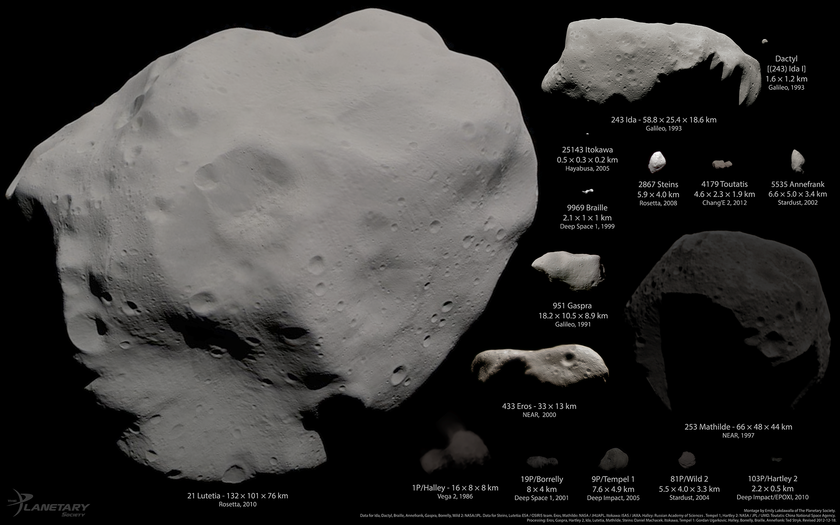
Emily Lakdawalla of the Planetary Society has put together aN asteroids-and-coments montage.
- LRK -

-----------------------
My ever-popular asteroids-and-comets montage, now in color, with bonus Toutatis
Posted By Emily Lakdawalla
2012/12/18 04:26 CST
My collage of all the asteroids and comets visited by spacecraft is probably the single most popular image I have ever posted on this blog. I've now updated it to be in color and to include Toutatis, which Chang'E 2 photographed last week. When I first started working on a color version, it didn't seem to hang together very well as a composition, because the colors were all over the map. But when I hit upon the idea of trying to represent the bodies with correct relative brightness, it seemed to come together nicely. Vesta is not included because it dwarfs the others. (I'd have to increase the height and width of the montage by factors of three.)
Asteroids and comets visited by spacecraft as of December 2012, in color, excepting Vesta
Montage by Emily Lakdawalla. Data from NASA / JPL / JHUAPL / UMD / JAXA / ESA / OSIRIS team / Russian Academy of Sciences / China National Space Agency. Processed by Emily Lakdawalla, Daniel Machacek, Ted Stryk, Gordan Ugarkovic.
https://planetary.s3.amazonaws.com/assets/images/9-small-bodies/2012/20121218_asteroids_comets_sc_0-000-100_2012_color_brightened_f840.png
Asteroids and comets visited by spacecraft as of December 2012, in color, excepting Vesta
A montage of 16 of the 17 asteroids and comets that have been photographed up close as of December 2012, when Chang'E 2 flew past Toutatis. This version is in color and shows the bodies at their correct relative (though not absolute) albedo or brightness. Not included is Vesta, which would cover an area about three times the width and height of this montage.

snip
-----------------------


Some information on spacecraft that have visited asteroids and coments.
- LRK -

List of asteroids visited by spacecraft

Category:Comets visited by spacecraft

snip
-----------------------

NASA images Touatis with ground radar.
- LRK -

-----------------------
Asteroid Toutatis Slowly Tumbles by Earth
by Staff Writers
Pasadena CA (JPL) Dec 17, 2012

Scientists working with NASA's 230-foot-wide (70-meter) Deep Space Network antenna at Goldstone, Calif., have generated a series of radar data images of a three-mile-long (4.8-kilometer) asteroid that made its closest approach to Earth on Dec. 12, 2012.

The images that make up the movie clip were generated with data taken on Dec. 12 and 13, 2012. On Dec. 12, the day of its closest approach to Earth, Toutatis was about 18 lunar distances, 4.3 million miles (6.9 million kilometers) from Earth. On Dec. 13, the asteroid was about 4.4 million miles (7 million kilometers), or about 18.2 lunar distances.

The radar data images of asteroid Toutatis indicate that it is an elongated, irregularly shaped object with ridges and perhaps craters. Along with shape detail, scientists are also seeing some interesting bright glints that could be surface boulders.

Toutatis has a very slow, tumbling rotational state. The asteroid rotates about its long axis every 5.4 days and precesses (changes the orientation of its rotational axis) like a wobbling, badly thrown football, every 7.4 days.The orbit of Toutatis is well understood. The next time Toutatis will approach at least this close to Earth is in November of 2069, when the asteroid will safely fly by at about 7.7 lunar distances, or 1.8 million miles (3 million kilometers).
snip
------------------------


China's flyby of Toutatis with Chang'e-2 spacecraft.
- LRK -

-----------------------
China Makes First Asteroid Fly By
by Staff Writers
Beijing (XNA) Dec 17, 2012
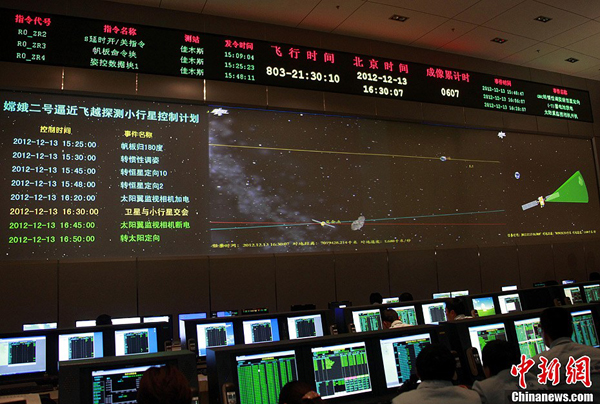
China's space probe Chang'e-2 has successfully conducted a maneuver in which it flew by the asteroid Toutatis, about seven million km away from the Earth.

Travelling in deep space, Chang'e-2 made the flyby on Dec. 13 at 16:30:09 Beijing Time (08:30"09 GMT), the State Administration of Science, Technology and Industry for National Defense (SASTIND) announced on Saturday.

The flyby was the first time an unmanned spacecraft launched from Earth has taken such a close viewing of the asteroid, named after a Celtic god.

It also made China the fourth country after the United States, the European Union and Japan to be able to examine an asteroid by spacecraft.

Chang'e-2 came as close as 3.2 km from Toutatis and took pictures of the asteroid at a relative velocity of 10.73 km per second, the SASTIND said in a statement.

Sources with the administration told Xinhua that Chang'e-2 is continuing its deep space travel and will reach a distance of more than 10 million km away from Earth in January next year.

Chang'e-2 was launched on Oct. 1, 2010 from Xichang Satellite Launch Center and later orbited the moon to finish a more extensive probe than its predecessor Chang'e-1.

Chang'e-2 left its lunar orbit for an extended mission to the Earth-Sun L2 Lagrangian point on June 9, 2011, after finishing its lunar objectives, which collected data for a complete lunar map.

The probe departed from L2 this year and began its mission to Toutatis.snip
-----------------------

Post Cina . org
- LRK -

You are here: Home > China > Nation
Chinese space probe flies by asteroid Toutatis
Xinhua, December 15, 2012

China's space probe Chang'e-2 has successfully conducted a maneuver in which it flew by the asteroid Toutatis, about seven million km away from the Earth.

China's space probe Chang'e-2 has successfully conducted a maneuver in which it flew by the asteroid Toutatis, about seven million km away from the Earth. [Photo: Chinanews.com]

Travelling in deep space, Chang'e-2 made the flyby on Dec. 13 at 16:30:09 Beijing Time (08:30"09 GMT), the State Administration of Science, Technology and Industry for National Defense (SASTIND) announced on Saturday.
The flyby was the first time an unmanned spacecraft launched from Earth has taken such a close viewing of the asteroid, named after a Celtic god.
It also made China the fourth country after the United States, the European Union and Japan to be able to examine an asteroid by spacecraft.
Chang'e-2 came as close as 3.2 km from Toutatis and took pictures of the asteroid at a relative velocity of 10.73 km per second, the SASTIND said in a statement.
snip
-----------------------

You can reach these celestial bodies with conventional rockets.  Just be prepared to spend a few years en route.

Thanks for looking with me.
=============================================
WHAT THE MIND CAN CONCEIVE, AND BELIEVE, IT WILL ACHIEVE - LRK -
=============================================

Friday, July 31, 2009

The Perseids are Coming

While planets may be hit by asteroids or comets, we can also pass through the debris from them.
Time to get out the easy chair and look up at the night sky.
See the link for more information on best viewing.
- LRK -

------------------------------------------------------------------
The Perseids are Coming
http://science.nasa.gov/headlines/y2009/31jul_perseids2009.htm?list965414

July 31, 2009: Earth is entering a stream of dusty debris from Comet Swift-Tuttle, the source of the annual Perseid meteor shower. Although the shower won't peak until August 11th and 12th, the show is already getting underway.

Brian Emfinger of Ozark, Arkansas, photographed this early Perseid just after midnight on Sunday, July 26th:

http://science.nasa.gov/headlines/y2009/images/perseids2009/Brian-Emfinger2.jpg

"I used an off-the-shelf digital camera to capture this fireball and its smoky trail," says Emfinger. "It was a bright one!"

Don't get too excited, cautions Bill Cooke of NASA's Meteoroid Environment Office. "We're just in the outskirts of the debris stream now. If you go out at night and stare at the sky, you'll probably only see a few Perseids per hour."

This will change, however, as August unfolds.

"Earth passes through the densest part of the debris stream sometime on August 12th. Then, you could see dozens of meteors per hour.
snip
------------------------------------------------------------------

John sent a link that might indicate that Venus can be hit by comets as Jupiter may have experienced of late.
- LRK -

------------------------------------------------------------------
http://www.livescience.com/space/090730-venus-bright-spot.html
Bright Spot on Venus Stumps Scientists
By Andrea Thompson, Senior Writer
posted: 30 July 2009 05:14 pm ET

A sudden bright spot that appeared in the clouds of Venus just days after a comet left a bruise on Jupiter has scientists stumped as to its cause.

Venus' bright spot, first noticed by amateur astronomer Frank Melillo of Holtsville, NY on July 19, is not the first such brightening noticed on our cloudy neighbor, said planetary scientist Sanjay Limaye of the University of Wisconsin-Madison.

"We have seen such events before," he told SPACE.com.
snip

http://www.space.com/scienceastronomy/090730-venus-bright-spot.html
------------------------------------------------------------------

And while you are looking up from the comfort of your easy chair you might contemplate the constellation of Orion and the bright, bright star Betelgeuse.
What if it exploded while you were looking at it?
Would you catch it on your digital camera?
- LRK -

Link thanks to SpaceWarper.
------------------------------------------------------------------
http://www.eso.org/public/outreach/press-rel/pr-2009/pr-27-09.html
ESO 27/09 - Science Release

29 July 2009
For immediate release
Sharpest views of Betelgeuse reveal how supergiant stars lose mass

Unveiling the true face of a behemoth

Using different state-of-the-art techniques on ESO's Very Large Telescope, two independent teams of astronomers have obtained the sharpest ever views of the supergiant star Betelgeuse. They show that the star has a vast plume of gas almost as large as our Solar System and a gigantic bubble boiling on its surface. These discoveries provide important clues to help explain how these mammoths shed material at such a tremendous rate.

Betelgeuse — the second brightest star in the constellation of Orion (the Hunter) — is a red supergiant, one of the biggest stars known, and almost 1000 times larger than our Sun [1]. It is also one of the most luminous stars known, emitting more light than 100 000 Suns. Such extreme properties foretell the demise of a short-lived stellar king. With an age of only a few million years, Betelgeuse is already nearing the end of its life and is soon doomed to explode as a supernova. When it does, the supernova should be seen easily from Earth, even in broad daylight.

snip
------------------------------------------------------------------

And if there are any life forms on planets in that area, will we receive a data dump of their life history in one last expression of their existence?
Will SETI pick up the death cry?
http://www.seti.org/Page.aspx?pid=1345

And if you were at Moon Base Alpha, would your radio telescope record the happening?
http://www.space1999.net/moonbase99/
http://www.space1999.net/

And if you would just like to go see the Moon using the new Google Earth information that NASA and JAXA have added information to, well check this out.
- LRK -

------------------------------------------------------------------
http://www.nasa.gov/centers/ames/news/features/2009/Google_Moon.html
NASA and Google Launch Virtual Exploration of the Moon
07.20.09

Forty years ago on July 20, 1969, the world watched as the crew of Apollo 11 took the first steps on the surface of the moon.

To celebrate this historic occasion, NASA and Google announced the launch of the Moon in Google Earth, an interactive, 3D atlas of the moon, viewable with Google Earth 5.0.

The announcement was made during a press conference at the Newseum in Washington, featuring remarks by Apollo 11 astronaut Buzz Aldrin; Alan Eustace, a Google senior vice president; Andrew Chaikin, author and space historian; and Anousheh Ansari, the first female space tourist.

With the Moon in Google Earth, users can explore a virtual moonscape, follow guided tours from astronauts Buzz Aldrin and Jack Schmidt, view high-resolution "street view" style panoramic images and see previously unreleased footage captured from the lunar surface.

Whether rediscovering iconic moments from the history of lunar exploration, or learning about them for the first time, the Moon in Google Earth enables users to better understand the moon and mankind's relationship to it using an immersive, 3D experience.

snip
http://earth.google.com/moon/
------------------------------------------------------------------

Thanks for looking up with me.


Larry Kellogg

Web Site: http://lkellogg.vttoth.com/LarryRussellKellogg/
BlogSpot: http://kelloggserialreports.blogspot.com/
RSS link: http://kelloggserialreports.blogspot.com/atom.xml
Newsletter: https://news.altair.com/mailman/listinfo/lunar-update
Twitter: http://twitter.com/lrkellogg
==============================================================