Thursday, June 26, 2014

Wired for War: The Robotics Revolution and Conflict in the 21st Century - & - The Dreams Our Stuff Is Made Of

Of late my posts to the lunar-update list have been rather spotty. I might blame distractions on this side from a hand that stings but I also have concerns about the direction of our space activities, like lack of funding or reasons for venturing off world.  Maybe I have lost some of the wonder of a 12 year old reading comic books and watching Buck Rogers.

I suppose one can become too concerned about the why and just report on what is actually happening, but let me bend your ear a bit.  

The first chapter, THE RIGHT TO LIE is found at The New York Times books section. Just a snip:
 "America is a nation of liars, and for that reason science fiction has a special claim to be our national literature, as the art form best adapted to telling the lies we like to hear and to pretend we believe.
    It has been said of Cretans that they were all liars, and we can assume, from its proscription in the Decalogue, that lying was not unknown in Mosaic times. What distinguishes American liars from those of earlier times and other nations is that the perfected American liar does not feel himself to be disgraced by his lies, even when he is caught in them. Indeed, the bolder the lie and the more brazenly imposed on the public, the more admiration the liar is accorded."
As you see, Disch makes the assertion that America is a "nation of liars." He goes through the history of Science Fiction and shows how the writings have targeted young boys who are willing to accept the portrayal of interplanetary war, drugs, and women as something that is OK to dream about. 

In fairness you may also want to look at a rebuttal to his book, but you would really need to have read the book to fully appreciate. "A Plague on All Your Houses"

When you look back at the 50's, 60's, and 70's you can see that the science fiction followed a lot of what was happening then.  Now this 12 year old is an adult and who is to say what I dreamed about, good or bad, is what I should be working on today. Have I been wired by my young dreams that might need revisiting? What is an acceptable way to let actions unfold? Have I considered what to do. and its effects, as well as what I don't have time to do, that limits what I could have been done?

A lot of what was foretold is now real life. Doors do open automatically when you approach.  No stage hand has to pull at the right time for Kirk to walk through a door on the Enterprise. Star Trek Rarities

Amazon.com would like to fly a quadcopter to your door step to deliver packages, but so far the FAA has denied permission. Deutsche Post (DHL) in Germany is experimenting with a ‘Paketkopter’ drone to deliver small loads like emergency medicine needs.

That is not quite the image of cars zooming at different levels as in the movies. 
The 10 Most Badass Fictional Flying Cars of Sci-Fi
It does seem that the FAA is concerned with how you will keep track of low flying robot copters. Not for profit now.

Also, our war machines have continued to evolve to the point you can use unpiloted airplanes, drones or Unmanned aerial vehicle (UAV) to take out the enemy in a land far, far away while sitting in a air conditioned cubicle in Nevada. Maybe it was an alien that has just landed or maybe it is someone that doesn't agree with the lie you were brought up with. 

If you are still with me, take a look at what Steve Grand wrote and take time to view the YouTube video that is suggested.  It is causing me to look out and down as well as to look up.

Back in July of 2010, Steve in his blog wrote, "Is the human brain still in beta?" (Or is it society that’s not yet fully debugged?)  Steve has been working on a program dealing with "Artificial Life."  
He starts of with, "I’m supposed to be working hard at the moment, which is, of course, why I’m spending far too much time on Facebook. Anyway, yesterday and today a series of disparate Facebook threads seemed to come together as if to raise a single question, so I thought I’d ask for opinions."  This follows with a number of examples of how people seem to be making questionable decisions that to them, seem to be alright, just because they have been deluded into accepting their decisions without really evaluating what the results may bring forth.

At the end of his blog there are some 59 comments one is from Bob Mottram who proposes that Steve might like to see if he hasn't already.  I would like to pass that link as it seems to be even more relevant today than 2009, with the number of military drones being flown and for what reason.
- LRK -

------------------------------------------------
Bob Mottram says:
Also on the topic of robotics and its military connections, if you havn’t seen it before I’d recommend this video on ethics in robotics:
Illah Nourbakhsh Lecture: Ethics in Robotics
Uploaded on Feb 13, 2009
Are there types of robots that shouldn't be created? Should we use robots in military combat? Or is there actually nothing to worry about? Carnegie Mellon Robotics Institute professor Illah Nourbakhsh addresses issues raised by recent book Wired for War by P.W. Singer and gives his personal take on ethics and robotics.
  • Category

  • License

    Standard YouTube License
...
------------------------------------------------

Related to the above would be a link from the end of Steve's post. 

His comment, "Let me finish with one last Facebook post. This one was a link to a robotics project that is clearly funded by, and heavily tailored towards, the Military. The research team is developing robot helicopters that can fly through windows and latch onto a target. It doesn’t take much imagination to see what military applications this might have, and those applications are potentially very destabilizing, because they provide the opportunity to blow people up at zero risk to the person who chooses to do it. Warfare evolved under fairer circumstances than these and we really don’t know what will happen when wars can be fought from an armchair."
- LRK -

------------------------------------------------
Autonomous quadrocopter flies through windows, straight into our hearts (video)BY VLAD SAVOV  4 YEARS AGO

We don't know whether we should be terrified or overjoyed. We've just come across a video demo from the University of Pennsylvania's GRASP Lab that shows an autonomousquadrotor helicopter performing "precise aggressive maneuvers." And trust us when we say, nothing in the foregoing sentence is an overstatement -- the thing moves with the speed and grace of an angry bee, while accompanied by the perfectly menacing whine of its little engine. See this work of scientific art in motion after the break.
...
------------------------------------------------

And from the author of the book, Wired for War: The Robotics Revolution and Conflict in the 21st Century, this talk, 
- LRK -

------------------------------------------------
Robots and War: Everything You Were Afraid to Ask..Afraid to

Uploaded on Mar 2, 2009
P. W. Singer, a Senior Fellow and Director of the 21st Century Defense Initiative at the Brookings Institution, and author...

...
------------------------------------------------

I watched Star Trek (1966–1969) while I watched Apollo 11: Launch July 16, 1969 (turn up the volume and run through some power amps to shake the walls) and Apollo11: Lunar Landing July 20, 1969 and didn't think anything about the cardboard sets for Star Trek, but then I think I was still in the child like, 12 year old mold. We could go to the Moon, we could go anywhere.  I had watched 2001: A Space Odyssey and read the book a number of times. My brother told me about the music and I told him about the science. And then in 1984 - 2010: The Year We Make Contact  
- LRK -

------------------------------------------------
Uploaded on Mar 26, 2009
Original 1984 motion picture trailer.
"ALL THESE WORLDS
ARE YOURS EXCEPT
EUROPA
ATTEMPT NO
LANDING THERE
USE THEM TOGETHER
USE THEM IN PEACE"
...
------------------------------------------------

Today I look at things a bit different.  I don't see us lifting my city of Tracy, with a population estimated 84,691, to some orbital city in orbit or floating through space but there have been a number of science fiction novels with this theme and we hold design contests at NASA Ames for students around the world. (see I need to update my old web site.) If not an actual space city then maybe the development of the Moon to support such ideas in the event it really becomes necessary to send some of our seed off world.  I am not the only one who has talked about setting up shop on the Moon. 

Is that something that should really be done?  Have we looked at the benefits and what doesn't get done if we spend our time, energy, obsession, and resources to accomplish?  Life in a spacesuit doesn't sound like a fun way to take a drive on the Moon.

Since I have been presenting a number of items that may make us think about reasons for going to space or not, let me leave you with Hamish LIndsy's web site and his information on Apollo 17.
- LRK -

------------------------------------------------
Apollo 17

7–20 December 1972

by Hamish Lindsay
...
------------------------------------------------

There is good reason to keep us up to date on what is happening that is space related and I will see if I can't do a better job of that.
At the same time I think I shall also take a closer look at why we are flying above the ground even if it is within our atmosphere.
It may lead us to better understand why we will or will not spend time and money to send humans to space.
And by 'we' I mean the US taxpayer.  I don't think I will be going to space.  Will you be going to space? 
Will you sponsor someone for a space trip? (crowd source for a small bit of memorabilia)
-----
ISEE-3 Reboot Project by Space College, Skycorp, and SpaceRef
06/26/14: Just as our DSN window closed today we were able to get 2 way Doppler lock and ranging at 47.5 kHz offset.  DSN got the four ranging points needed from ISEE-3. This is the first time since 1999 that DSN has talked to the spacecraft. Follow up session tomorrow should get us a lot more recording time.
...
---
============================================
WHAT THE MIND CAN CONCEIVE, AND BELIEVE, IT WILL ACHIEVE - LRK -
============================================

Wednesday, June 18, 2014

The ISEE-C Plasma Wave Investigation

Well what do you think, a spacecraft, one of a number, that spent time investigating energy fields that are near us in space, and then off to feel the effects of flying through a comets tail. Now it has returned to interest us again.

When you see a picture of the planets on paper they are just flat objects with no life, just pretty objects.  Not the case in real life. They are moving through space and interacting with the various electric and magnetic fields in space.  Scientists try to visualize how this all takes place and play with mathematics and reams of paper.  The more real data points they can get, the better they can match their theories with what is really out there.  A very dynamic situation.

Take a look at this training website showing some ideas in graphic form.
It is a 51 page PDF file that gives a lot of information about the Maagnetosphere.
This is part of what ISEE-C and its partners were gathering data to study.
Now put yourself on the Moon during a full moon as you pass the shadowed side of Earth and pass through this magnetosphere.
Do you feel that.  And what about the Northern Lights?
Take a look.
- LRK -

------------------------------------------------
The Earth’s magnetosphere
text-book chapters 13 – 15,
except reconnection (14.2–3) and convection (15.2–3)

What is a magnetosphere?
• Term introduced by Thomas Gold in 1959
- Earth’s magnetic field determines the motion of the charged particles
• Not a “sphere”
- solar wind deforms the shape of the magnetosphere
• Proper magnetospheres (objects with internal B)
- Mercury, Earth, Jupiter, Saturn, Uranus, Neptune
- neutron stars, pulsars, …
- magnetized moons (Ganymede) and asteroids (Gaspra?)
- actually also the environments of stars and galaxies belong to this group
• Solar wind-induced magnetospheres
- Venus, Mars, comets
Inline image 1
Earth Magnetosphere graphic - See link for more information and graphics - LRK -
...
------------------------------------------------

If you took a look you found that you need to understand some mathematics.  Not my best subject.
It does interest a number of scientists though.
- LRK -

------------------------------------------------
SPECIAL ISSUE ON
INSTRUMENTATION FOR THE INTERNATIONAL SUN-EARTH EXPLORER SPACECRAFT

List of Papers.
- LRK -

Plasma and Energetic Particle Upstream of a Quasi-Parallel Interplanetary Shock

[17 page PDF with a number of figures with plots and images. - LRK - ]
...
------------------------------------------------

A four page PDF paper, just one of many papers.
- LRK -

------------------------------------------------
The ISEE-C Plasma Wave Investigation
F. L. SCARF, R. W. FREDRICKS, D. A. GURNETT, AND E. J. SMITH

[Just 4 page PDF file with circuitry, images and charts. - LRK - ]
...
------------------------------------------------

If you have some money burning a hole in your pocket, like $152, then take a look at what has been written in book form.
- LRK -

------------------------------------------------

Earth's Magnetosphere: Formed by the Low-Latitude Boundary Layer [Hardcover]

by W.J. Heikkila

The author argues that, after five decades of debate about the interactive of solar wind with the magnetosphere, it is time to get back to basics. Starting with Newton's law, this book also examines Maxwell's equations and subsidiary equations such as continuity, constitutive relations and the Lorentz transformation; Helmholtz' theorem, and Poynting's theorem, among other methods for understanding this interaction.


  • Includes chapters on prompt particle acceleration to high energies, plasma transfer event, and the low latitude boundary layer
  • More than 200 figures illustrate the text
  • Includes a color insert
More »
...
------------------------------------------------

The NASA page on the ISEE-3 mission.
- LRK -

------------------------------------------------
ISEE-3

NSSDC/COSPAR ID: 1978-079A

The Explorer-class heliocentric spacecraft, International Sun-Earth Explorer 3, was part of the mother/daughter/heliocentric mission (ISEE 1, 2, and 3). The purposes of the mission were: (1) to investigate solar-terrestrial relationships at the outermost boundaries of the Earth's magnetosphere; (2) to examine in detail the structure of the solar wind near the Earth and the shock wave that forms the interface between the solar wind and Earth's magnetosphere; (3) to investigate motions of and mechanisms operating in the plasma sheets; and, (4) to continue the investigation of cosmic rays and solar flare emissions in the interplanetary region near 1 AU.

The three spacecraft carried a number of complementary instruments for making measurements of plasmas, energetic particles, waves, and fields. The mission thus extended the investigations of previous IMP spacecraft. The launch of three coordinated spacecraft in this mission permitted the separation of spatial and temporal effects. This heliocentric spacecraft had a spin axis normal to the ecliptic plane and a spin rate of about 20 rpm. It was initially placed into an elliptical halo orbit about the Lagrangian libration point (L1) 235 Earth radii on the sunward side of the Earth, where it continuously monitored changes in the near-Earth interplanetary medium. In conjunction with the mother and daughter spacecraft, which had eccentric geocentric orbits, this mission explored the coupling and energy transfer processes between the incident solar wind and the Earth's magnetosphere. In addition, the heliocentric ISEE 3 spacecraft also provided a near-Earth baseline for making cosmic-ray and other planetary measurements for comparison with corresponding measurements from deep-space probes. ISEE 3 was the first spacecraft to use the halo orbit.
...
------------------------------------------------

And the Wikipedia article.
- LRK -

------------------------------------------------
International Cometary Explorer

The International Cometary Explorer (ICE) spacecraft (designed and launched as the International Sun/Earth Explorer 3 (ISEE-3) satellite), was launched August 12, 1978, into a heliocentric orbit. It was one of the three spacecraft, along with a mother/daughter pair (ISEE-1 and ISEE-2), of the ISEE (International Sun-Earth Explorer) international cooperative program between NASA and ESRO/ESA to study the interaction between the Earth's magnetic field and the solar wind.
ISEE-3 was the first spacecraft to be placed in a halo orbit at one of Earth-Sun Lagrangian points (L1). Renamed ICE, it became the first spacecraft to visit a comet, passing through the tail of Comet Giacobini-Zinner within about 7,800 km of the nucleus.[1]
NASA officially suspended contact with ISEE-3 in 1997.[2] After 17 years of no contact, a group of amateurs called the ISEE-3 Reboot Project, with some support from the Skycorp company, established two-way communication with the spacecraft on May 29, 2014.[3][4]
...
ISEE3-ICE.jpg
------------------------------------------------
Look at the list of instruments on the ISEE-3/ICE.
- LRK -

------------------------------------------------
Solar System Exploration

ISEE-3/ICE

Mission Type: Flyby, Orbiter
Launch Vehicle: Delta 2914 (no. 144 / Thor no. 633)
Launch Site: Cape Canaveral, USA, Launch Complex 17B
NASA Center: Goddard Space Flight Center
Spacecraft Mass: 479 kg
Spacecraft Instruments: 1) solar wind plasma experiment; 2) magnetometer ; 3) low-energy cosmic-ray experiment; 4) medium-energy cosmic-ray experiment; 5) high-energy cosmic-ray experiment; 6) plasma waves experiment; 7) protons experiment; 8) cosmic-ray electrons experiment; 9) X-rays and electrons experiment; 10) radio mapping experiment ; 11) plasma composition experiment; 12) high-energy cosmic-rays experiment and 13) ground-based solar studies experiment
Spacecraft Dimensions: 16-sided body 1.7 meters in diameter, 1.6 meters high
Spacecraft Power: solar cells
Maximum Power: 173.0 W (nominal power)
Maximum Data Rate: Nominally 2048 bps during the early part of the mission, and 1024 bps during the Giacobini-Zinner encounter. The bit rate finally dropped to 64 bps (on 12/27/91)
References:
Deep Space Chronicle: A Chronology of Deep Space and Planetary Probes 1958-2000, Monographs in Aerospace History No. 24, by Asif A. Siddiqi

National Space Science Data Center, http://nssdc.gsfc.nasa.gov/

Solar System Log by Andrew Wilson, published 1987 by Jane's Publishing Co. Ltd.
...
------------------------------------------------

You see others are talking and I am just slow to pick up.
- LRK -

------------------------------------------------
TALLBLOKE'S TALKSHOP

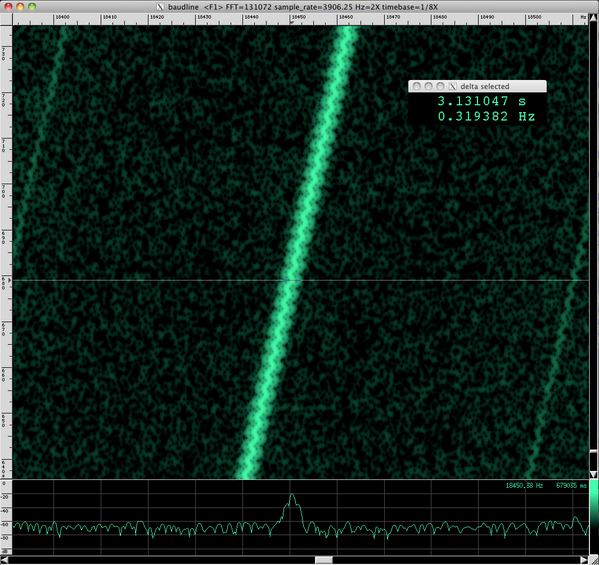
This is a plot of signal received from the satellite and an overlay of the theoretic signal. Carrier (the spike) and modulation sidebands. The frequency will move with time because of doppler, spacecraft and earth are moving relative to each other.

...
There is really a lot to understand and a lot of topics that could be considered.  It helps to be on the inside to fully grasp the jargon.
It is easy to graduate from college, get a PHD, and then spend a career on a mission if you get in on the planning stages and endure the delays, have a successful mission, and maybe participate in an extended mission.  You may even be reincarnated and get to take part in something like the Reboot ISEE-3 Project.  :-)
I can't help it.  Just one more time for the link to the ISEE-3 REBOOT PROJECT
http://spacecollege.org/isee3/
Thanks for looking up with me.
- LRK -
===========================================
WHAT THE MIND CAN CONCEIVE, AND BELIEVE, IT WILL ACHIEVE - LRK -
===========================================

Tuesday, June 17, 2014

Calling Back a Zombie Ship From the Graveyard of Space - another view

ISEE-3 Reboot Project

On the FPSPACE list David R. Woods posted a link to a New York Times article about the ISEE-3 Reboot Project.
It is a nice summary and has some nice images.
Enjoy.
- LRK -

------------------------------------------------
By JUNE 14, 2014

For 17 years, it has been drifting on a lonely course through space. Launched during the disco era and shuttered by NASA in 1997, the spacecraft is now returning to the civilization that abandoned it.

It seemed destined to pass without fanfare, except for a slight chance of slamming into the moon, and then loop aimlessly through the inner solar system.

But now, a shoestring group of civilians headquartered in a decommissioned McDonald’s have reached out and made contact with it — a long-distance handshake that was the first step toward snaring it back into Earth’s orbit.

The zombie spaceship is coming home.
...
...
In 1999, the agency upgraded its Deep Space Network, the system of radio telescopes that communicates with distant space probes. The old transmitters that could talk with ISEE-3 were thrown away.

But ISEE-3 was never turned off, so while Earth lost its ability to talk to it, ISEE-3 was still broadcasting, waiting for its next command.

In 2008, the Deep Space Network listened briefly at the faraway spot where ISEE-3 was and heard the carrier frequency of the spacecraft’s radio — essentially a dial tone.

Two years later, NASA looked into reviving contact for the 2014 flyby, but concluded that the scientific payoff would not be worth the effort and money. Fans of the old spacecraft persisted, arguing that it could be used to train future scientists and engineers. But in February, Leonard N. Garcia, a NASA employee who had set up a Facebook page promoting ISEE-3, conceded that it was not going to happen. New transmitters could be built, he wrote, “but it would be at a price no one is willing to spend.”

That caught Mr. Wingo’s attention. “Not only is it not impossible,” he said, “I think it can work, and I know how to do it.”
...
------------------------------------------------

Do read the above link for another look at what can be done when you set your mind to it.
It also helps to gather together kindred spirits that complement each other.
- LRK -

------------------------------------------------
Video: The ISEE-3 Song

Tim Reyes (ISEE-3 team member): I sought someone to write a song. Local friends pointed to me and I was given a chance to contribute in this way to bring public awareness back to the long-lost spacecraft, ISEE-3.

[Go to the link to hear her sing the song. - LRK -  ] 

Artwork/Painting by Evan Nozaki - http://evnozaki.deviantart.com
Video Recorded by Nicole Morena (Super rad friend)
Lyrics by Tim Reyes (Former NASA employee):
You chose a new path for me and I left them and you behind
Off to see two comets of the Sun, tell us what you find
Send the words out until they reach the Earth to feed our thoughtful minds
A reminder of where we were, what we sought and still to find
ISEE-3 here and you are not far
Send me a command and let's see if I understand
And so you will go back to Arecibo and continue to command
So much has changed since you were not far
Let's go by the Moon, by the Earth, and return to stand above
You are like old but something new, something borrowed and somewhat blue
Closer in, together, made a team to deliver news to you
We were extensions of your fingers, my companions spun and swirled
Spinning at twenty revs per minute I could never see around
But ISEE-3 here and you are not far
Send me a command and let's see if I understand
And so you will go back to Arecibo and continue to command
So much has changed since you were not far
Let's go by the Moon, by the Earth and return to stand above
So much has changed since you were not far
We are not fragmented like continents when you left
Time has stood still for me but my electrics carry on
70s plaid, solar arrays but they keep picking at the sun
Send me a command and let's see if I understand
And so you will go back to Arecibo and command
So much has changed since you were not far
Let's go by the Moon, by the Earth and return to stand above 

Yeah let's go by the moon, and return to stand above

------------------------------------------------

It is interesting when you try to talk to an old, old, spacecraft that has been orbiting the Sun for years.
Know the feeling of expectation and crossed fingers.
I remember when Pioneer six was contacted after 35 years.
- LRK -

------------------------------------------------
The Pioneer Missions
March 26, 2007

...
Pioneer 6-9
Pioneers 6-9 were launched into Solar orbit between 1965 and 1968. Their prime mission completed years ago, the spacecraft were then tracked only occasionally.

Pioneer 6 was launched on 16 December 1965. Some time after 15 December 1995 (almost 30 years after it was launched) the primary transmitter (TWT) failed. During a track on 11 July 1996 the spacecraft was commanded to switch to the backup TWT, and the downlink signal was re-acquired. The spacecraft and a few of the science instruments were again functioning.

Pioneer 6 is the oldest NASA spacecraft extant. There was a successful contact of Pioneer 6 for about two hours on 8 December 2000 to commemorate its 35th anniversary.

Pioneer 7 was launched on 17 August 1966. It was last tracked successfully on 31 March 1995. The spacecraft and one of the science instruments were still functioning.

Pioneer 8 was launched on 13 December 1967. Its primary TWT failed several years ago, but on 22 August 1996 the spacecraft was commanded to switch to the backup TWT, and the downlink signal was re-acquired. The spacecraft and one of the science instruments were again functioning.

Pioneer 9 was launched on 8 November 1968. The spacecraft failed in 1983.
...
------------------------------------------------
I hope you have a chance to check in on their progress.
Thanks for looking up with me.
- LRK -
WHAT THE MIND CAN CONCEIVE, AND BELIEVE, IT WILL ACHIEVE - LRK -
============================================

Friday, June 13, 2014

ISEE-3 Reboot Project

There has been an interesting project going on which I have been remiss in mentioning.
You probably have been reading about it while I was visiting a granddaughters graduation.

If you check out the links you will see how a group of folks have gotten permission to see if they could restart a NASA satellite that had finished several missions and was turned off and left to go on its marry way, It just so happens its orbit has brought it back to our area in space and this sparked an interest in seeing how it has survived.

The big antenna at Arecibo, Pureto Rico has been used by SETI before to listen to signals from space and the weak signal of Pioneer 10 was ideal for testing.  See the following link for more infromation.
------------------------------------------------
Arecibo, Puerto Rico 1998 - 2004

Overview 1998
The Project Phoenix Targeted Search System (TSS) returned to the world's largest telescope after an eventful six years. In 1992, when the SETI Institute was last observing in Puerto Rico, the TSS had less than half its current capability and was operated as part of NASA's High Resolution Microwave Survey. Since then, the U.S. Congress cancelled the HRMS, Project Phoenix was born, and Arecibo was closed for several years for major upgrades.

With a system designed to pick up interstellar communication signals operating with the world's largest telescope, it's not surprising that we can detect our own technological civilization. In this page we will present some examples of terrestrial signals.

Our favorite signal (until we get the one from ETI) is from the Pioneer 10 spacecraft. Launched in 1972, it now at a distance of roughly 10,000,000,000 kilometers. Its aging transmitter broadcasts with a power of only a few watts. The huge collecting area of the Arecibo antenna brings it in loud and clear.

Pioneer 10 is now at a distance of more than 11,000,000,000 km (about 6.9 billion miles). It takes more than 10 hours for its radio signal, travelling at the speed of light, to reach the Earth. After more than 10,000 days of continuous operation, the electronics in its transmitter are beginning to deteriorate. In spite of this, the signal from Pioneer 10 is still an excellent test for our system.
...
Pioneer 10 Signal

This plot shows the power in 924 channels over time. Each horizontal row of dots gives a snapshot of the amount of power in each of the channels at a specific time. The larger the dot, the more power in that channel. Every 0.7 seconds a new row of dots is added. Over about two minutes the picture shown to the left builds up. If a particular channel always had a signal in it, we would see a vertical line since that channel would always have a more power than the other channels, and so would tend to have larger than average dots.

...
------------------------------------------------

Enough about Pioneer 10.  What you want to see for this project is information about ISEE-3.
- LRK -

------------------------------------------------
Recently in ISEE-3 Reboot Project Category
Continued ISEE-3 Detection With an 8 Foot DIsh
By Keith Cowing on June 10, 2014 9:28 AM

View image on Twitter

This Doppler oscillation measurement shows that the  
spacecraft is spinning at 19.163 ±0.02 RPM. @ISEE3Reboot 
...
ISEE-3 Status Report 9 June 2014 (Afternoon)
By Keith Cowing on June 9, 2014 11:45 PM

During our pass at Arecibo today (remotely conducted via laptop in McMoons in California) we switched ISEE-3's B transmittier to a data rate of 64 bps. We hope to eventually leave it this way so as to allow dishes smaller than Arecibo (such as the one at Morehead State University) to complete the link and have solid two-way communication with ISEE-3. Participants in today's pass: McMoons, Bochum Observatory in Germany, and Arecibo Observatory in Puerto Rico. Our next pass at Arecibo opens tomorrow (Tuesday) around 2:30 pm EDT.
...
More plots and information at the website.  Take a look. - LRK -
------------------------------------------------

You might well like to know more about ISEE-3, the International Sun/Earth Explorer 3 or ICE as it was named International Cometary Explorer in its follow on mission to a comet tail.  - LRK -

------------------------------------------------
International Cometary Explorer

The International Cometary Explorer (ICE) spacecraft (designed and launched as the International Sun/Earth Explorer 3 (ISEE-3) satellite), was launched August 12, 1978, into a heliocentric orbit. It was one of the three spacecraft, along with a mother/daughter pair (ISEE-1 and ISEE-2), of the ISEE (International Sun-Earth Explorer) international cooperative program between NASA and ESRO/ESA to study the interaction between the Earth's magnetic field and thesolar wind.
ISEE-3 was the first spacecraft to be placed in a halo orbit at one of Earth-Sun Lagrangian points (L1). Renamed ICE, it became the first spacecraft to visit a comet, passing through the tail of Comet Giacobini-Zinner within about 7,800 km of the nucleus.[1]
NASA officially suspended contact with ISEE-3 in 1997.[2] After 17 years of no contact, a group of amateurs called the ISEE-3 Reboot Project, with some support from the Skycorp company, established two-way communication with the spacecraft on May 29, 2014.[3][4]
...
ISEE3-ICE.jpg
------------------------------------------------
How do you fund a project like this if you are not on NASA's payroll?
- LRK -

------------------------------------------------
ISEE-3 Reboot Project by Space College, Skycorp, and SpaceRef

05/29/14: The ISEE-3 Reboot Project is pleased to announce that our team has established two-way communication with the ISEE-3 spacecraft and has begun commanding it to perform specific functions.  Over the coming days and weeks our team will make an assessment of the spacecraft's overall health and refine the techniques required to fire its engines and bring it back to an orbit near Earth.

First Contact with ISEE-3 was achieved at the Arecibo Radio Observatory in Puerto Rico. We would not have been able to achieve this effort without the gracious assistance provided by the entire staff at Arecibo.  In addition to the staff at Arecibo, our team included simultaneous listening and analysis support by AMSAT-DL at the Bochum Observatory in Germany, the Space Science Center at Morehead State University in Kentucky, and the SETI Institute's Allen Telescope Array in California
...
$159,602
Raised towards
$125,000 goal
------------------------------------------------

If you haven't been following this project you might like to look at an earlier post where they were planning for first contact.
There is quite a learning curve when you try to put together equipment to talk to a spacecraft and then are trying to write software to command it.
I can relate to their effort having written software to use down link data from Pioneer 10 that had documentation with entries that would be supplied later, TBD. 
At least I had software print outs that I could read what the numbers were.
- LRK -

------------------------------------------------
http://spacecollege.org/isee3/isee-3-reboot-project-status-and-schedule-for-first-contact.html
ISEE-3 Reboot Project Status and Schedule for First Contact
By Keith Cowing on May 15, 2014 11:37 AM

Dennis Wingo: Today's update regards the progress of the ISEE-3 Reboot Project team in our preparations to contact the spacecraft. We started this effort 32 days ago on on April 12, 2014. Below is what we have accomplished in that time - and the challenges that lie ahead.
...
------------------------------------------------
I hope you have a chance to check in on their progress.
Thanks for looking up with me.
- LRK -
===========================================
WHAT THE MIND CAN CONCEIVE, AND BELIEVE, IT WILL ACHIEVE - LRK -
===========================================

Tuesday, May 20, 2014

The Vision for Space Exploration February 2004

Going to the Moon, Mars, or even the stars, may well be just something for those that dream while looking up at the heavens above on a story night, but dream we do.  This is not a new idea, just one that is a lot closer to being possible.

While working at NASA Ames Research Center for 20 years, I saw support for such ideas come and go.  Even so, you could find groups interested in  going to the Moon or Mars even if there were no posters on the walls.
Now and then it would be politically correct to dream out loud.  In 2004 the posters went up, all hands meetings were held, and plush publications were handed out.
I am still sorting through stacks of papers from my time at Ames, and trying to prove I am not a horder. Tomorrow is paper, plastic recycle day and sat down to shred old emails.   Picked up a folder with the following NASA publication. NP- 2004-01-334
- LRK -
-------------------------------------------------
The Vision for Space Exploration - NASA
www.nasa.gov/pdf/55583main_vision_space_exploration.pdf
by E Cernan
Space Administration. The Vision for Space. Exploration. February 2004 ... new approach to space exploration using a “building block” strategy to
-------------------------------------------------.
Nice pictures, charts, time lines, the whole big picture,  and look we are planning to go back to the Moon with humans. Many smiling faces at Ames because the underground lunatics could now speak openly. Of course there were those that feared their program.would have cutbacks in funding.
- LRK -
--------------------------------------------------
President Bush Announces New Vision for Space Exploration Program
history.nasa.gov/Bush%20SEP.htm
Jan 14, 2004 - January 2004 · December 2003 ... February 2003 ... President Bush Announces New Vision for Space Exploration Program Remarks by the .
http://history.nasa.gov/Bush%20SEP.htm
--------------------------------------------------
Do read the above speech and dream for a moment because we woke up to the reality that funding another Apollo type mission wasn't that easy to support.  A different political wind was blowing.
- LRK -
Made the front page of the Ames Astrogram.
---------------------------------------------------
http://www.nasa.gov/centers/ames/pdf/80095main_01_04Astrogram.pdf
During an historic announcement delivered Jan.14, 2004 from NASA Headquarters in Washington, D.C., President George W. Bush unveiled a sweeping new vision for the nation’s space exploration program and outlined the key roles NASA
Bush, whose remarks were broadcast live on NASA television, was joined by NASA Administrator Sean O’Keefe as he committed the nation to a longterm human and robotic program to explore space, starting with the moon and later Mars and other destinations in the solar system.
----------------------------------------------------
Well the words sounded good.  Is it true?
"This cause of exploration and discovery is not an option we choose;  It is a desire written in the human heart." - President Bush
Okay I guess I will put these back in the expandable folder.  Maybe find some other papers to stuff in it as I dream on.  Still trying to fill up the recycle bin with shreded paper.
Thanks for looking up with me.
- LRK -
Web Site: http://lkellogg.vttoth.com/LarryRussellKellogg/
BlogSpot: http://kelloggserialreports.blogspot.com/
WordPress: http://lrkellogg.wordpress.com/
==============================================================
WHAT THE MIND CAN CONCEIVE, AND BELIEVE, IT WILL ACHIEVE - LRK -
==============================================================

Monday, May 19, 2014

Life in space is impossible.

The space review blog has an interesting piece about living in space or really, living in space, really?
Follow your imagination,  but what do you need to stimulate that imagination?  As a kid I had the Saturday matinee and Buck Rogers.  Boxes made my flight simulator. 
Today our 7 year old granddaughter just tells me to ask my smartphone when I don't know the answer to her questions.   She isn't interested in going to space when she can build a cave with blankets and chairs right here on Earth. She doesn't need to wear a spacesuit that wears her fingertips raw.
Will we fix a dying planet or just abandon it?  What do I do with the book case of science fiction? How about my books on artificial life or robots that talk and smile?  Do I need them to live in space or do I just have fun here on Earth.  Well not to worry, at 76 years I think any fun I have will probably be done from my couch.:-)
What about the 7 year old granddaughter?
Does she have to go to the Moon, Mars, or Beyond to flex her imagination?
Or does she just continue to paint her pictures of SpongeBob?
- LRK -
--------------------------------------------
http://www.thespacereview.com/article/2516/1
Life in space is impossible
The tag line for the new Christopher Nolan movie Interstellar premiering in November could have been written by a space settlement enthusiast: “Mankind was born on Earth, it was never meant to die here.” Based upon the newly released trailer, however, it appears as if humanity’s salvation is not asteroid mining or Mars settlement, but sending a spaceship to another solar system (because “nothing in our solar system can save us”). Quite possibly the answer is “aliens.”
--------------------------------------------
Interstellar -- Trailer -- Official Warner Bros.: http://youtu.be/zSWdZVtXT7E

When you look at the space review article be thinking about where you would like to see the future develope.  Your ideas appreciated.
Thanks for looking up with me.
- LRK -
WHAT THE MIND CAN CONCEIVE, AND BELIEVE, IT WILL ACHIEVE - LRK -
============================================

ISEE/ICE reboot effort

If a spacecraft that was launched long ago comes back near to Earth after a long journey in space, can you wake it up and tell it to get back to work sensing the Earth's magnetic field?  Who would fund such a project? Read on.
- LRK -

The ISEE-3 Reboot Project intends to contact the ISEE-3 (International Sun-Earth Explorer) spacecraft, command it to fire its engines and enter an orbit near Earth, and then resume its original mission - a mission it began in 1978.
ISEE-3 Reboot Project by Space College, Skycorp, and SpaceRef

--------------------------------------------
image
ISEE-3 Reboot Project Status
and Schedule for First Cont...
Technical Progress The Learning
Curve
...
--------------------------------------------

--------------------------------------------
Recently in About Category

By Keith Cowing on March 14, 2014 11:01 AM
Space College Foundation, Inc. (Space College) is a Virginia-based nonprofit organization. Our mission is to provide access to educational resources, career opportunities, and hands-on involvement in space exploration. While our main focus is on learning after high school, we strive to support learning about space exploration for students of all ages. More information on Space College can be found here.

Space College is wherever you are....
--------------------------------------------

--------------------------------------------
http://spacecollege.org/
ISEE-3 Away Team Is at Arecibo
...
--------------------------------------------

--------------------------------------------
The International Cometary Explorer (ICE) spacecraft was originally known as International Sun/Earth Explorer 3 (ISEE-3) satellite, launched August 12, 1978. It was part of the ISEE (International Sun-Earth Explorer) international cooperative program between NASA and ESRO/ESA to study the interaction between the Earth's magnetic field and the solar wind. The program used three spacecraft, a mother/daughter pair (ISEE-1 and ISEE-2) and a heliocentric orbit spacecraft (ISEE-3, later renamed ICE).

ISEE-3 was the first spacecraft to be placed in a halo orbit at one of Earth-Sun Lagrangian points (L1). It was later (as ICE) sent to visit Comet Giacobini-Zinner and became the first spacecraft to do so by flying through acomet's tail passing the nucleus at a distance of approximately 7800 km.[1] ICE was not equipped with cameras.
ISEE3-ICE.jpg
...
ICE's current trajectory will bring it close to Earth in August 2014.[4] On February 4, 2014, the Goddard Space Flight Center announced that the Deep Space Network equipment necessary to transmit signals to the spacecraft had been decommissioned in 1999, and that replacing it was not economically feasible.[6] But an 18-meter satellite dish at the Johns Hopkins Applied Physics Laboratory does still have the right hardware, and NASA gave them approval to try to achieve contact. If they can get it to change its orbit by late May or early June, it could use the Moon's gravity to get back into a halo orbit from which it could once again perform its original mission. This is the only realistic chance to do that.[7]

In April 2014 the ISEE-3 Reboot Project was announced. According to their website "Our plan is simple: we intend to contact the ISEE-3 (International Sun-Earth Explorer) spacecraft, command it to fire its engine and enter an orbit near Earth, and then resume its original mission - a mission it began in 1978. ISEE-3 was rechristened as the International Comet Explorer (ICE). If we are successful it may also still be able to chase yet another comet. Working in collaboration with NASA we have assembled a team of engineers, programmers, and scientists - and have a large radio telescope fully capable of contacting ISEE-3. If we are successful we intend to facilitate the sharing and interpretation of all of the new data ISEE-3 sends back via crowd sourcing."[8]

On May 15 2014 the crowd-funding goal of US$ 125 000 for the reboot project was reached.
...
--------------------------------------------

Thanks for looking up with me.
- LRK -

============================================

WHAT THE MIND CAN CONCEIVE, AND BELIEVE, IT WILL ACHIEVE - LRK -

============================================