Showing posts with label Chang'e 3. Show all posts

Tuesday, December 31, 2013

Chang’e 3's landing cushion technology employs superplastic materials.

When Apollo 11 landed on the Moon there was a need to provide a way to cushion the landing and a crushable aluminum-honeycomb cartridge was used.

Now I see the term 'superplastic' used in relation to the cushion technology for Chang'e 3 lander. 

Wasn't familiar with the term and still a bit confused as the immediate information seems to be about being able to form materials.  

Superplastic, sounds so simple, just maybe some stretchy thing, but what really?  

Stretch, crush, either way, a lot of testing.  Landing your egg on the Moon without breaking the shell. What would you design?
- LRK -

------------------------------------------
...
Landing System
In its ambitious landing sequence, the Chang’e 3 lander is dropped from an altitude of 4 meters which required a cushioning landing system on the lander to create a fairly soft landing. The system also has to support the Rover release that is performed after landing. A “cantilever-type” design has been selected for Chang’e 3.

The landing system utilizes four primary landing legs that are equipped with footpads to avoid sinking into the surface. The Chinese used previous lander designs and knowledge on the properties of the lunar dust to develop a landing system that minimizes mass while maximizing stability.

The primary landing struts facilitate bumpers with interior buffer elements to provide shock-absorbing capabilities. The legs are installed at a 30° angle to the lander structure. Multi-functional and single-functional secondary struts are attached to the landing legs to provide additional attach points to the lander body. 
Two secondary struts are attached to each of the landing legs. Those also provide flexibility and shock-absorbing capabilities. Chang’e 3's landing cushion technology employs superplastic materials.  [emphases mine - LRK -]
...
------------------------------------------

Porous and Cellular Materials for Structural Applications - 318 pages PDF - 
You may not be up to reading 318 pages but a look at the table of contents might be informative.
- LRK -

------------------------------------------
  1. [PDF]

    Porous and Cellular Materials for Structural Applications - Defense ... 

    by DS Schwartz - 1998 - Cited by 43 - Related articles
    Superplastic Foaming of Titanium and Ti-6AI-4V 231 ..... Volume 532—Silicon Front-End Technology—Materials Processing and Modelling, N.E.B. ..... the collapse stress, oc*, is important in the design of cushions for shock or impact ...... employed to analyze the effect of indenting geometry on the Brinell hardness of sintered  ...
    ..
    ------------------------------------------
Still not seeing what was done.
- LRK -

------------------------------------------
Superplasticity
In materials sciencesuperplasticity is a state in which solid crystalline material is deformed well beyond its usual breaking point, usually over about 200% during tensile deformation. Such a state is usually achieved at high homologous temperature, typically half the absolute melting point. Examples of superplastic materials are some fine-grained metals and ceramics. Other non-crystalline materials (amorphous) such as silica glass ("molten glass") and polymers also deform similarly, but are not called superplastic, because they are not crystalline; rather, their deformation is often described as Newtonian flow. Superplastically deformed material gets thinner in a very uniform manner, rather than forming a "neck" (a local narrowing) that leads to fracture.[1] Also, the formation of microvoids, which is another cause of early fracture, is inhibited.[citation needed]
In metals and ceramics, requirements for it being superplastic include a fine grain size (less than approximately 20 micrometres) and a fine dispersion of thermally stable particles, which act to pin the grain boundaries and maintain the fine grain structure at the high temperatures and Existence of Two Phases required for superplastic deformation. Those materials that meet these parameters must still have a strain rate sensitivity (a measurement of the way the stress on a material reacts to changes in strain rate) of >0.3 to be considered superplastic.
The mechanisms of superplasticity in metals are still under debate—many believe it relies on atomic diffusion and the sliding of grains past each other. Also, when metals are cycled around their phase transformation, internal stresses are produced and superplastic-like behaviour develops. Recently high-temperature superplastic behaviour has also been observed in iron aluminides with coarse grain structures. It is claimed that this is due to recovery and dynamic recrystallization.[2]
  1. ^ G. E. Dieter, Mechanical Metallurgy, Third Edition, McGraw-Hill Inc., 1986, p. 299–301 and 452–453, ISBN 0-07-016893-8.
  2. ^ Sharma, Garima; Kishore, R.; Sundararaman, M.; Ramanujan, R.V. (15 March 2006). "Superplastic deformation studies in Fe-28Al-3Cr intermetallic alloy"Materials Science and Engineering: A 419 (1–2): 144–147. doi:10.1016/j.msea.2005.12.015.
  3. ^ T. G. Nieh, J. Wadsworth and O. D. Sherby (1997). Superplasticity in metals and ceramics. Cambridge University Press. pp. 240–246. ISBN 978-0-521-56105-....
------------------------------------------

Could something like this be used?
- LRK -

------------------------------------------
CHINA SCIENCE AND TECHNOLOGY 
NEWSLETTER 
The Ministry of Science and Technology 
People's Republic of China 

No. 470
March 3 0,2007
...
Super Plastic Bulk Metallic Glasses 
A research team, led by WANG Weihua at the Institute of Physics, part of the Chinese Academy of Sciences, has successfully worked out super plastic bulk metallic glasses at room temperature, through binding the seemingly unbinding properties. The finding was published in a recent issue of journal Science. 
In contrast to the poor plasticity that is usually observed in bulk metallic glasses, super plasticity is achieved at room temperature in ZrCuNiAl synthesized through the appropriate choice of its composition by controlling elastic moduli. Microstructures analysis indicates that the super plastic bulk metallic glasses are composed of hard regions surrounded by soft regions, which enable the glasses to undergo true strains. This finding is suggestive of a solution to the problem of brittleness in, and has implications for understanding the deformation mechanism of metallic glasses. 
As the elements used in the new metallic glasses are popular metals that can be procured at a reasonable price, the new finding has created an important scientific and application perspective for the material. 
...
------------------------------------------

Well I didn't see a definitive answer to exactly what was used to cushion the Chang'e 3 lander.
Maybe you saw something I missed.
Superplastic, nice sound, hmmmm.
- LRK -

Thanks for looking up with me. 
- LRK -
=============================================

WHAT THE MIND CAN CONCEIVE, AND BELIEVE, IT WILL ACHIEVE - LRK -

=============================================

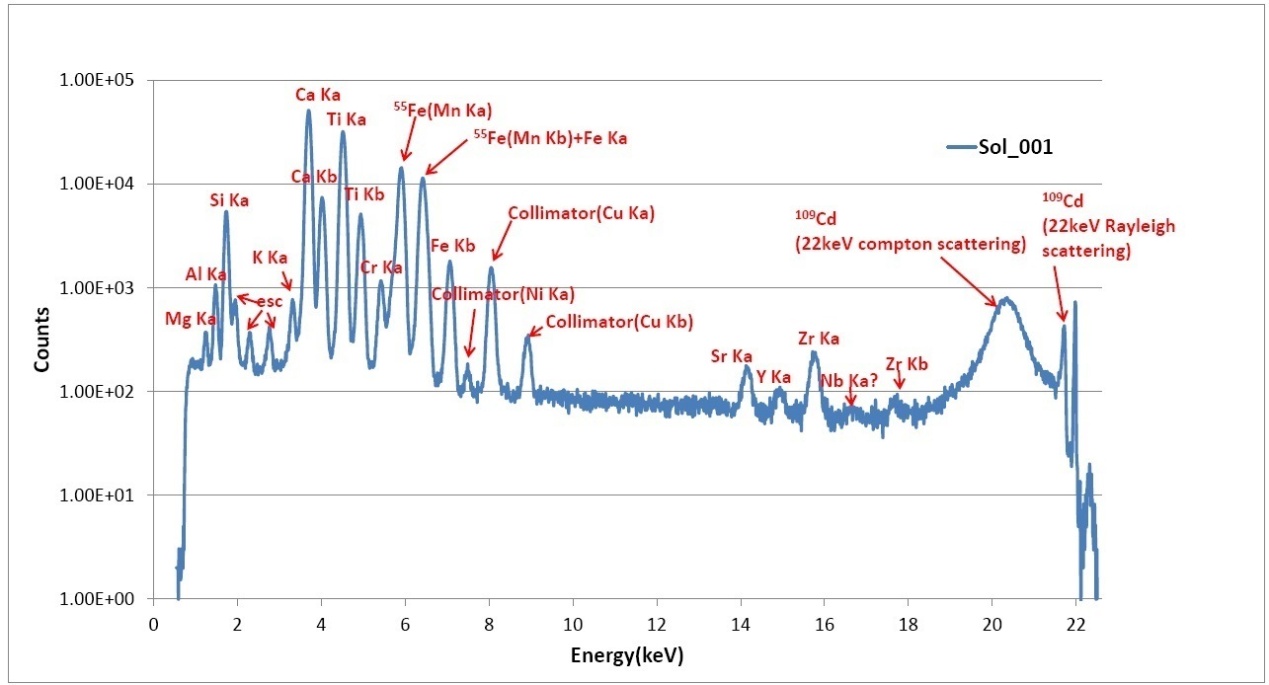
CHANG’E-3 SATELLITE PAYLOAD APXS OBTAINED ITS FIRST SPECTRUM OF LUNAR REGOLITH

And the adventure begins.  Have a happy new year.
- LRK -
Figure 3 First X-ray fluorescent spectrum of lunar regolith obtained by APXS (image by IHEP)  SEE LINK BELOW FOR MORE IMAGES. - LRK -
------------------------------------------
Text & Images:
http://english.ihep.cas.cn/prs/ns/201312/t20131230_115114.html

CHANG’E-3 SATELLITE PAYLOAD APXS OBTAINED ITS FIRST SPECTRUM OF LUNAR REGOLITH

The Active Particle-induced X-ray Spectrometer (APXS), carried by the Yutu rover of the Chang’e-3 satellite, got its first X-ray fluorescence spectrum of lunar regolith around the landing site on December 25, 2013.

An initial analysis indicates that eight major rock-forming elements (Mg, Al, Si, K, Ca, Ti, Cr and Fe) and at least 3 minor elements (Sr, Y and Zr) of the Moon can be identified in this spectrum. Besides, the energy resolution of APXS is estimated to be about 135 @ 5.9 keV, which demonstrates that it is currently one of the best X-ray spectrometers for planetary exploration in the world.

APXS was firstly powered on December 23, and an in-flight calibration of a standard basalt rock sample mounted on the rover was accomplished in five minutes, which proved its stable performance on the Moon. Two days later, APXS was successfully deployed to about two to three centimeters above the lunar regolith surface by the robotic arm of Yutu and started the detection mode. APXS was not only an X-ray spectrometer, but also served as a distance sensor during the deployment by making use of how X-ray count rate varied with distance.

The Institute of High Energy Physics (IHEP) developed APXS in collaboration with the Purple Mountain Observatory (PMO), CAS. Prior to the APXS on Chang’e-3, two X-ray spectrometers onboard Chang’e-1 and Chang’e-2 developed by IHEP scientists were launched respectively in October 2007 and October 2010.

Contact:
Mr. Xu Tongzhou
IHEP Public Affairs
+86 10-8823-5008
xutz@ihep.ac.cn
Copyright ©2002-2013 Institute of High Energy Physics, CAS
Questions and Comments to webmaster@ihep.ac.cn
mailing address:19B YuquanLu, Shijingshan District 
Beijing, 100049 FAX: 86-10-88233374 TEL: 86-10-88233093 

------------------------------------------
Guang Pu Xue Yu Guang Pu Fen Xi. 2013 May;33(5):1360-3.

[Near infrared distance sensing method for Chang'e-3 alpha particle X-ray spectrometer].

[Article in Chinese]

Abstract

Alpha particle X-ray spectrometer (APXS) is one of the payloads of Chang'E-3 lunar rover, the scientific objective of which is in-situ observation and off-line analysis of lunar regolith and rock. Distance measurement is one of the important functions for APXS to perform effective detection on the moon. The present paper will first give a brief introduction to APXS, and then analyze the specific requirements and constraints to realize distance measurement, at last present a new near infrared distance sensing algorithm by using the inflection point of response curve. The theoretical analysis and the experiment results verify the feasibility of this algorithm. Although the theoretical analysis shows that this method is not sensitive to the operating temperature and reflectance of the lunar surface, the solar infrared radiant intensity may make photosensor saturation. The solutions are reducing the gain of device and avoiding direct exposure to sun light.
PMID:
 
23905352
  
[PubMed - in process]

------------------------------------------
Guang Pu Xue Yu Guang Pu Fen Xi. 2012 Jul;32(7):1965-8.

[Temperature effect correction for Chang'E-3 alpha particle X-ray spectrometer].

[Article in Chinese]

Abstract

Alpha particle X-ray spectrometer (APXS) is one of the payloads of Chang'E-3 lunar rover of China's Lunar Exploration Project. The present paper introduces briefly the components of APXS, how it works and its working environment on the lunar surface. The environmental temperature effect has been studied with simulations and experiments, and the results show that the temperature of the APXS sensor will be varying during the measuring on the lunar surface. And another experiment reveals that the energy resolution becomes worse if the sensor's temperature is varying. In this paper, a correction method based on Pearson's chi-squared test is presented. The method can improve the energy resolution when the sensor's temperature is varying. We have tested the method with the spectra acquired by APXS in the temperature varying period of Temperature Cycling Test, and the results show that the method is efficient and reliable.
PMID:
 
23016364
  
[PubMed - in process]

------------------------------------------
...
APXS (Alpha Particle X-Ray Spectrometer):
APXS was developed by IHEP (Institute of High Energy Physics) of CAS. The objective is to measure the composition and distribution of various elements on the lunar surface by observing the scattered X-rays from the bombardment of alpha particles on rocks. Located on the rover’s robotic arm, APXS is capable of active particle scattering, in-situ determination of lunar surface elements, in-orbit calibration and distance measurement functions. The sensor can re-calibrate itself through the use of standard calibration targets, and the rover's lunar night survival contains a RHU (Radioisotope Heater Unit) for keeping the sensor warm. It has low energy consumption, low mass, high resolution, and high sensitivity semi-conductor sensors are used.
Change3_Auto0
Figure 17: APXS components (from left to right): sensor head, RHU & calibration target (image credit: CLEP, Ref. 2)
1) “Chang'e 3,” Dragon in Space, URL: http://www.dragoninspace.com/planetary/change3.aspx
2) Patrick Blau, “Chang'e 3 - Mission Overview,” Spaceflight 101, URL:http://www.spaceflight101.com/change-3.html
...
------------------------------------------

Read more about China's Chang'e 3 mission.
- LRK -

Thanks for looking up with me. 
- LRK -
============================================

WHAT THE MIND CAN CONCEIVE, AND BELIEVE, IT WILL ACHIEVE - LRK -

============================================

Saturday, December 14, 2013

China’s Chang’e-3 and Jade Rabbit duo land on the Moon

The Chang'e 3 mission duo have landed on the Moon.
Check out the NASA Spaceflight.com pictures and text.
- LRK -

-------------------------------------------
China’s Chang’e-3 and Jade Rabbit duo land on the Moon
December 14, 2013 by Rui C. Barbosa

China’s Chang’e-3 and the lunar rover Yutu (Jade Rabbit) have landed on the lunar surface at 1:11 pm UTC on Saturday. The duo were launched by a Long March 3B on December 1, which was followed by a nominal flight into lunar orbit and subsequently China’s first soft landing on the Moon.
...
-------------------------------------------

Also the previous Spaceflight.com post for more information.
- LRK -

-------------------------------------------
Chang’e-3: Chinese lunar rover heading to the Moon
December 1, 2013 by Rui C. Barbosa

The Chinese have begun their most ambitious lunar mission to date, following the successful launch their Long March 3B rocket carrying the Chang’e-3 probe and Yutu lunar rover. Launch was on schedule at 17:30 UTC on Sunday, taking place from the LC2 Launch Complex at the Xichang Satellite Launch Center.
...
-------------------------------------------

Watch a YouTube presentation of landing with images and Chinese and English commentary.
- LRK -

-------------------------------------------
China's Chang'e 3 JADE RABBIT landed on the Moon!! LIVE Footage From MOON
 ...
-------------------------------------------

And a bit from THE INDEPENDENT, Saturday 14 December 2013.
- LRK -

-------------------------------------------
China's Jade Rabbit rover lands on moon
HEATHER SAUL 
 Saturday 14 December 2013

China has reported landing its Jade Rabbit rover on the moon, in the first soft landing of a rover in nearly four decades today, the latest step in the country's ambitious space programme.

The Chang'e 3 lander was scheduled to touch down at 9.40pm local time (1.40pm GMT).

State television showed pictures of the moon's surface as the Chang'e 3 lander touched down shortly before this.

The lander carries the moon rover called Yutu, or “Jade Rabbit” which was launched onboard the Chang'e 3 rocket on 1 December. After landing, the rover is slated to separate from the Chang'e and begin a three-month scientific exploration, looking for natural resources.
...
-------------------------------------------

Hopefully there will be more videos after the stored data is received and further check out is completed.
Feel free to let me know if you spot something of interest.
- LRK -

Thanks for looking up with me.  
- LRK -
 
=============================================

WHAT THE MIND CAN CONCEIVE, AND BELIEVE, IT WILL ACHIEVE - LRK -

=============================================

Thursday, December 12, 2013

Lunar Soil - the fine fraction of the regolith found on the surface of the Moon.

With the present interests in what is going on at our Moon and about to happen with the Chang'e 3 mission, you might wonder if there is any possibility to put humans there again. If you just stay for three days you can bring your own box lunches.  If you really want to think about staying for any extended time you may want to grow some fresh vegetables. 

Easier said than done. Down here on Earth, just throw some soil in a pot, some seeds, add some water, air, and light. Maybe control the temperature range. [brrr, it has been cold this last week and the pepper plant leaves have curled up.]

Hmm, at the lunar environment the composition of soil is different than what I might get here for potting soil. The more we learn about what is available on the Moon, the better we will be able to prepare our indoor hot house.  The less we have to bring up to the Moon the better. 

Both the Chang'e 3 lander and rover will help analyze soil samples and a later mission plans to return some lunar soil to Earth.

Since we will need to dig in to be protected from solar radiation it will be good to know what is under the lunar soil. The Chang'e Jade Rabbit rover has a ground penetrating radar that should be useful. 

- LRK -

Check out the references to the Wikipedia articles that follow. - LRK -
-------------------------------------------
Chang'e 3 (Chinese嫦娥三号pinyinCháng'é Sānhào) is a lunar exploration mission operated by the China National Space Administration, incorporating a robotic lander and a rover. Chang'e 3 was launched on the morning of 2 December 2013 local time (17:30 1 December UTC), which is part of the second phase of the Chinese Lunar Exploration Program.[5][9][10] It will be China's first lunar rover.
The spacecraft is named after Chang'e, the goddess of the Moon in Chinese mythology, and is a follow-up to the Chang'e 1 and Chang'e 2 lunar orbiters. The lunar rover is called Yutu, or Jade Rabbit, a name selected in an online poll that comes from a Chinese myth about a white rabbit that lives on the Moon as a companion of the moon goddess Chang'e.[11] It achieved lunar orbit on 6 December 2013 (Beijing time).[12]
...
This article or section documents a current or recent spaceflight. Details may change as the mission progresses.
-------------------------------------------

A look at what lunar soil is.
- LRK -

-------------------------------------------

Lunar soil is the fine fraction of the regolith found on the surface of the Moon. Its properties can differ significantly from those of terrestrial soil. The physical properties of lunar soil are primarily the result of mechanical disintegration of basaltic and anorthositic rock, caused by continuous meteoric impact and bombardment by interstellar charged atomic particles over billions of years. The process is largely one of mechanical weathering in which the particles are ground to finer and finer size over time. This situation contrasts fundamentally to terrestrial soil formation, mediated by the presence of molecular oxygen (O2), humidity, atmospheric wind, and a robust array of contributing biological processes. Some have argued that the term "soil" is not correct in reference to the Moon because on the Earth, soil is defined as havingorganic content, whereas the Moon has none. However, standard usage among lunar scientists is to ignore that distinction.
The term lunar soil is often used interchangeably with "lunar regolith" but typically refers to only the finer fraction of regolith, that which is composed of grains one cm in diameter or less.[1] Lunar dust generally connotes even finer materials than lunar soil. There is no official definition of what size fraction constitutes "dust", some place the cutoff at less than 50 micrometres in diameter, others at less than 10.
...
-------------------------------------------

Not all of the Moon's surface is pulverized to dust and so we will need to be able to adapt to varying terrain.
- LRK -

-------------------------------------------
 
Regolith is a layer of loose, heterogeneous material covering solid rock. It includes dustsoil, broken rock, and other related materials and is present on Earth, the Moon, Mars, some asteroids, and other terrestrial planets and moons.
...
Moon
Regolith covers almost the entire lunar surface, bedrock protruding only on very steep-sided crater walls and the occasional lava channel. This regolith has formed over the last 4.6 billion years from the impact of large and small meteoroids, from the steady bombardment of micrometeoroids and from solar and galactic charged particles breaking down surface rocks.
The impact of micrometeoroids, sometimes travelling faster than 60,000 mph (96,000 km/h), generates enough heat to melt or partially vaporize dust particles. This melting and refreezing welds particles together into glassy, jagged-edged agglutinates,[2] reminiscent oftektites found on Earth.
The regolith is generally from 4 to 5 metres thick in mare areas and from 10 to 15 metres in the older highland regions.[3] Below this true regolith is a region of blocky and fractured bedrock created by larger impacts, which is often referred to as the "megaregolith".
...
-------------------------------------------

The more real lunar soil samples we have the better lunar soil simulant that can be created. These are needed when you start thinking about using lunar materials for on site construction.  I wonder if any of the below is still available.

-------------------------------------------
Engineering, Construction, and Operations in Space IV
American Society of Civil Engineers, pp. 857-866, 1994

JSC-1: A NEW LUNAR SOIL SIMULANT

David S. McKay, James L. Carter, Walter W. Boles,

Carlton C. Allen, and Judith H. Allton

A new lunar soil simulant, JSC-1, has been developed and characterized under the auspices of the NASA Johnson Space Center. This simulant was produced in large quantities to satisfy the requirements of a variety of scientific and engineering investigations. JSC-1 is derived from volcanic ash of basaltic composition, which has been ground, sized, and placed into storage. The simulant's chemical composition, mineralogy, particle size distribution, specific gravity, angle of internal friction, and cohesion have been characterized and fall within the ranges of lunar mare soil samples. JSC-1 is available for only the cost of shipping.

...
-------------------------------------------

Well it looks like some other more recent sources have been made. 

And CAS-1 Lunar Soil Simulant from China..


Thanks for looking up with me.  
- LRK -
 
============================================

WHAT THE MIND CAN CONCEIVE, AND BELIEVE, IT WILL ACHIEVE - LRK -

============================================

Wednesday, December 11, 2013

China’s Maiden Moon Rover Mission Chang’e 3 Achieves Lunar Orbit with the touchdown scheduled for some time Dec. 14.

We see that Chang'e 3 has achieved lunar orbit and is preparing to land on the Moon.
Things will really get interesting should the landing be successful. 
Much to learn about our nearest celestial neighbor. 
- LRK -

-------------------------------------------
China’s Maiden Moon Rover Mission Chang’e 3 Achieves Lunar Orbit
China’s maiden moon landing probe successfully entered lunar orbit on Friday, Dec. 6, following Sunday’s (Dec. 1) spectacular blastoff – setting the stage for the historic touchdown attempt in mid December.

Engineer’s at the Beijing Aerospace Control Center (BACC) commanded the Chang’e 3 lunar probe to fire its braking thrusters for 361 seconds, according to China’s Xinhua news agency.

The do or die orbital insertion maneuver proceeded precisely as planned at the conclusion of a four and a half day voyage to Earth’s nearest neighbor.

China’s ‘Yutu’ lunar lander is riding piggyback atop the four legged landing probe during the history making journey from the Earth to the Moon.
-------------------------------------------

Dwayne Day talks about the implications of the Chang'e mission.
- LRK -

-------------------------------------------
It’s not bragging if you do itby Dwayne Day
Monday, December 9, 2013

Later this week, if all goes according to plan, China will land a robotic spacecraft and rover on the Moon, something that nobody has done in nearly four decades. If the Chinese do what they did for the launch, they will broadcast much of the event live on television and over the Internet. Last week’s launch coverage on government-controlled English language CCTV was remarkable for its openness. Indeed, the coverage was indistinguishable from Western news coverage of a major space event. There was no propagandizing or nationalistic chest-thumping, just a straightforward reporting with lots of information about the mission and what was happening. The event, and its coverage, highlighted the fact that China has an attractive, technically sophisticated scientific space program that could serve international relations purposes. It was a demonstration of what American political scientist Joseph Nye has referred to as “soft power,” the ability to compel or attract nations to do what you want. China’s space program gives them this ability to attract partners. The problem is that some of China’s other activities undercut their attractiveness as a potential partner.
...
-------------------------------------------

Some more at SPACEFLIGHT NOW
- LRK -

-------------------------------------------
http://www.spaceflightnow.com/china/change3/131206loi/#.Uqi8pPRDua-
Chinese probe arrives in lunar orbit for moon landing
BY STEPHEN CLARK
SPACEFLIGHT NOW

Posted: December 6, 2013

Less than five days after leaving Earth atop a blazing Long March launcher, China's Chang'e 3 spacecraft reached lunar orbit Friday to prepare for an historic rocket-assisted touchdown in the moon's Bay of Rainbows later this month.

Outfitted with a six-wheeled robotic rover and smarts to avoid hazards in the landing zone, Chang'e 3 is China's boldest unmanned space mission to date, extending feats achieved by a pair of lunar orbiters launched in 2007 and 2010.

The four-legged lander fired its propulsion system for six minutes and braked into orbit around the moon at 0953 GMT (4:53 a.m. EST) Friday, according to China's state-run Xinhua news agency.
...
-------------------------------------------

With LADEE looking at the Moon we should get some idea of what going back to the Moon will do to the tenuous lunar atmosphere.


Take a look again at again at what the Planetary Society blog has to say.

-------------------------------------------
Chang'e 3 and LADEE updates -- and Lunar Reconnaissance Orbiter, too, for good measure
Posted by Emily Lakdawalla
2013/12/05 08:40 CST
Topics: pretty pictures, Lunar Reconnaissance Orbiter, mission status, LADEE, the Moon, Chang'E program

Update Dec 6 7:54 a.m. PT: Chang'e 3 has arrived in lunar orbit.

Chang'e 3 is just about to land on the Moon, and the LADEE orbiter has begun a new science mission there, while Lunar Reconnaissance Orbiter is still producing amazing images.
-------------------------------------------

Thanks for looking up with me.  
- LRK -
 
============================================

WHAT THE MIND CAN CONCEIVE, AND BELIEVE, IT WILL ACHIEVE - LRK -

============================================

Sunday, February 17, 2013

Go China, go China, go China's Chang'E 3 - To The Moon


I might say go USA - NASA, but I am not sure anyone is listening.
The following link has a number of images and a video clip.
- LRK -

---------------------------------------------
The Chang'e 3 lunar lander and rover, expected to launch late this year

Posted By Emily Lakdawalla

2013/01/09 03:46 CST

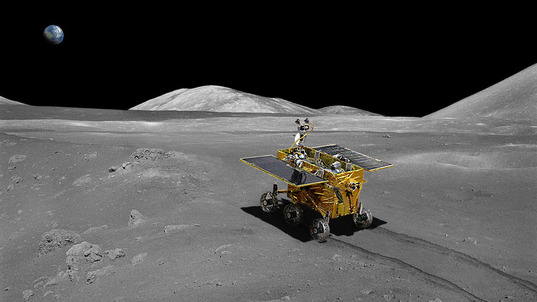
One of the missions planned for launch this year is China's Chang'E 3. I had never paid any attention to Chang'E 3 until this week, so I had no idea how large or ambitious it is. Chang'E 3 is a 1200-kilogram, RTG-powered lunar soft lander with a 1-year nominal mission lifetime. On top of that, it includes a 100-kilogram rover equipped with cameras and APXS. The rover has a nominal lifetime of 3 months and range of 10 kilometers. Wow. Here's a cool artist's concept that Glen Nagle put together. Enjoy it -- this is the first time it's been published!
Artist's concept of Chang'e 3 rover on the Moon
Glen Nagle
Artist's concept of Chang'e 3 rover on the Moon
I find that the best place on the Internet to find information and links about Asian missions is NASAspaceflight.com. Following is a summary of information from links posted within the NASAspaceflight Chang'E 3 forum. Many thanks to all the participants in that forum for sharing all this helpful information! I've collected all the photos of Chang'E 3 that I could find there and put them into a single Flickr album:

snip
---------------------------------------------

And from DRAGON IN SPACE
- LRK -

---------------------------------------------
Chang'e 3

Chang’e 3 is the third robotic lunar probe mission of the China Lunar Exploration Programme (CLEP). Scheduled to be launched in 2013~14, the probe will soft-land on the Moon surface and deploy an unmanned Lunar Rover to explore the areas surrounding the landing spot. The mission is heded by the State Administration of Science, Technology and Industry for National Defence (SASTIND) and the primary contractor for the probe is the China Academy of Space Technology (CAST) of the China Aerospace Science & Technology Corporation (SASC).

snip
---------------------------------------------

Chang'e 3 at Wikipedia
- LRK -

---------------------------------------------
Chang'e 3 is a lunar exploration mission operated by China National Space Administration, incorporating a robotic lander and a rover. Chang'e 3 is scheduled for launch in late 2013 as part of the second phase of the Chinese Lunar Exploration Program.[1][5] It will be China's first lunar rover, and the first spacecraft to make a soft landing on the Moon since the Soviet Luna 24 mission in 1976.[6] It is named after Chang'e, the Chinese goddess of the Moon, and is a follow-up to the Chang'e 1 and Chang'e 2 lunar orbiters.

snip
---------------------------------------------

At NASA WATCH
- LRK -

---------------------------------------------

If Chang'e-3 Lands, Google Lunar X Prize Drops by 25%

By Keith Cowing on November 14, 2012 2:40 PM

Summary of Rules and Requirements, Google Lunar X Prize
"The competition's grand prize is worth $20 million. To provide an extra incentive for teams to work quickly, the grand prize value will change to $15 million whenever a government-funded mission successfully explores the lunar surface, currently projected to occur in 2013."
"Ma said the Chang'e-3 would probe and explore the lunar surface, and carry out various environmental and space technology related tests. It will spend 15 days on the moon to lay the foundations of what he called, further deep space exploration."
snip
---------------------------------------------

This could be an interesting year so I will just say - GO, GO, GO to the MOON - ANYONE !!! - START A GOLD RUSH.

Thanks for looking up with me.  
- LRK -
 
==============================================

WHAT THE MIND CAN CONCEIVE, AND BELIEVE, IT WILL ACHIEVE - LRK -

==============================================