Showing posts with label Toutatis. Show all posts

Saturday, January 19, 2013

Chang'e-2 - flyby of Toutatis presentation at 8th MEETING OF THE NASA SMALL BODIES ASSESSMENT GROUP

Chang'e 2 flyby of Toutatis (Han Li, Chinese Academy of Sciences)

The above topic was mentioned on the FPSPACE  list and I thought I would take a look.
- LRK -

-----------------------------

Small Bodies Assessment Group (SBAG)

The Small Bodies Assessment Group was established by NASA in March 2008 to identify scientific priorities and opportunties for the exploration of asteroids, comets, interplanetary dust, small satellites, and Trans-Neptunian Objects. SBAG also provides scientific input on the utility of asteroids and comets in support of human space activities. The group consists of several focus groups of open membership and an eight person steering committee. Input from the scientific community is actively sought. SBAG provides findings to NASA Headquarters, but does not make recommendations.

SBAG Charter

The SBAG is NASA's community-based forum designed to provide science input for planning and prioritizing the exploration of small bodies throughout the Solar System for the next several decades. It also provides input on how small bodies can be utilized in support of human space activities. The SBAG is chartered by NASA's Planetary Science Division and reports its findings at meetings of the Planetary Science Subcommittee of the NASA Advisory Council's Science Committee.  It is open to all interested scientists. The SBAG regularly evaluates the goals, objectives, investigations, and required measurements for the exploration of small bodies on the basis of the widest possible community outreach. If you are interested in becoming a member of SBAG, please fill out the Indication of Interest Form.

Recent Meeting

8th Meeting of the NASA Small Bodies Assessment Group Meeting
January 14–16, 2013
Washington, DC
snip
-----------------------------

Take a look at the Agenda and Presentations.
I will have to check out the PDF files.
- LRK -

-----------------------------

8th MEETING OF THE NASA SMALL BODIES ASSESSMENT GROUP

January 14–16, 2013
Liaison Capitol Hill
Washington DC

Agenda


MONDAY, January 14

8:30–9:15 a.m.Welcome. Activities since last meeting, PSS report, NEOO, Discovery and New Frontiers program status. (Mark Sykes, PSI; Lindley Johnson, NASA HQ)
snip
TUESDAY, JANUARY 15

Missions —
9:00–9:30 a.m.Hayabusa 2 (Jun Kawaguchi, JAXA)
9:30–10:15 a.m.Chang'e 2 flyby of Toutatis (Han Li, Chinese Academy of Sciences)
10:15–10:30 a.m.Toutatis radar imaging campaign (Michael Busch, UCLA by Webex)
10:30–10:45 a.m.Break
snip
-----------------------------

See abstracts of the previous meetings findings at the link and PDF files for more information.
Now I really have a lot to catch up on.
- LRK -

-----------------------------

SBAG Findings and NASA HQ Responses

FINDINGS FROM SBAG 7, JULY 10–11, 2012
 August 2, 2012 

(1) The Discovery program has substantially collapsed as a source of planetary missions. In its first decade (1992–2001), ten missions were selected for launch. During its second decade (2002–2011), only one was selected. 
Implementation of the planetary decadal survey recommendation for a 24–month cadence
of Discovery AOs is imperative. 

Merging the Mars Scout program with Discovery puts yet further pressure on this program. Restoring the Discovery program to two selections for launch per call is very important to
the future of American solar system exploration.

It is noted that one new selection is pending as of this date. The next planned Discovery opportunity is currently delayed until 2015. Within the resources it has for missions and mission planning activities, NASA and the Planetary Science Division should work to provide a Discovery opportunity sooner than 2015, as advocated by the decadal survey.

DISCOVERY HISTORY (Initial selections: NEAR, Pathfinder) 
AO Date      Missions (and year selected)
1994:           Lunar Prospector, Stardust (1995)
1996:           Genesis, CONTOUR  (1997)
1998:           Deep Impact, MESSENGER (1999)
2000:           Kepler, Dawn (2001)
2002:           *No AO Released*
2004:           *No Mission Selection*
2006:           GRAIL (2007)
2008:          *No AO Released*
2010:           Not yet selected (selection expected in 2012) 

snip
-----------------------------

So much to learn, so little time.
- LRK -

WHAT THE MIND CAN CONCEIVE, AND BELIEVE, IT WILL ACHIEVE - LRK -

============================================

Thursday, December 20, 2012

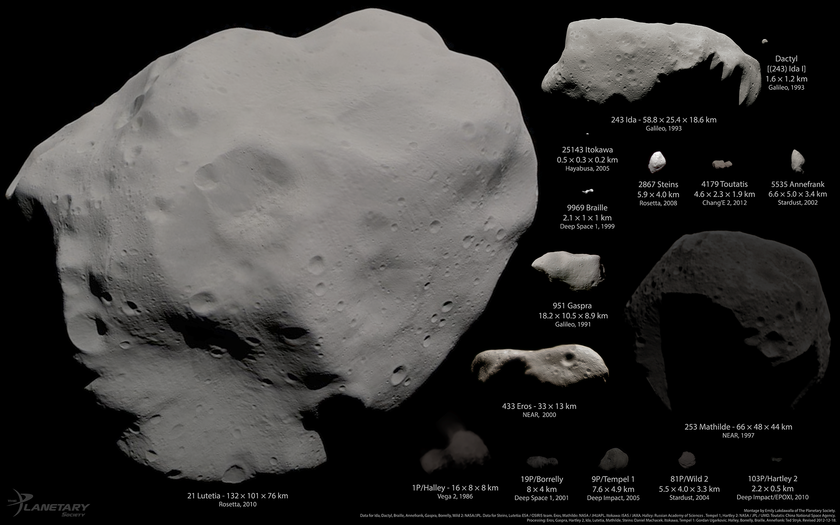
Asteroids and comets visited by spacecraft as of December 2012


Toutatis asteroid went by and China's Chang'E 2 photographed it but I didn't hear much fanfare.
There have been other asteroids and comets visited by spacecraft and hopefully the information obtained will be useful should we want to know how to change their orbits to avoid a collision with Earth or modify an orbit to capture one for space mining.  I hope we have some idea of their radiation history and what risks would be involved with sending humans  to one as I hear mumbles about doing so.
 - LRK -

Emily Lakdawalla of the Planetary Society has put together aN asteroids-and-coments montage.
- LRK -

-----------------------
My ever-popular asteroids-and-comets montage, now in color, with bonus Toutatis
Posted By Emily Lakdawalla
2012/12/18 04:26 CST
My collage of all the asteroids and comets visited by spacecraft is probably the single most popular image I have ever posted on this blog. I've now updated it to be in color and to include Toutatis, which Chang'E 2 photographed last week. When I first started working on a color version, it didn't seem to hang together very well as a composition, because the colors were all over the map. But when I hit upon the idea of trying to represent the bodies with correct relative brightness, it seemed to come together nicely. Vesta is not included because it dwarfs the others. (I'd have to increase the height and width of the montage by factors of three.)
Asteroids and comets visited by spacecraft as of December 2012, in color, excepting Vesta
Montage by Emily Lakdawalla. Data from NASA / JPL / JHUAPL / UMD / JAXA / ESA / OSIRIS team / Russian Academy of Sciences / China National Space Agency. Processed by Emily Lakdawalla, Daniel Machacek, Ted Stryk, Gordan Ugarkovic.
https://planetary.s3.amazonaws.com/assets/images/9-small-bodies/2012/20121218_asteroids_comets_sc_0-000-100_2012_color_brightened_f840.png
Asteroids and comets visited by spacecraft as of December 2012, in color, excepting Vesta
A montage of 16 of the 17 asteroids and comets that have been photographed up close as of December 2012, when Chang'E 2 flew past Toutatis. This version is in color and shows the bodies at their correct relative (though not absolute) albedo or brightness. Not included is Vesta, which would cover an area about three times the width and height of this montage.

snip
-----------------------


Some information on spacecraft that have visited asteroids and coments.
- LRK -

List of asteroids visited by spacecraft

Category:Comets visited by spacecraft

snip
-----------------------

NASA images Touatis with ground radar.
- LRK -

-----------------------
Asteroid Toutatis Slowly Tumbles by Earth
by Staff Writers
Pasadena CA (JPL) Dec 17, 2012

Scientists working with NASA's 230-foot-wide (70-meter) Deep Space Network antenna at Goldstone, Calif., have generated a series of radar data images of a three-mile-long (4.8-kilometer) asteroid that made its closest approach to Earth on Dec. 12, 2012.

The images that make up the movie clip were generated with data taken on Dec. 12 and 13, 2012. On Dec. 12, the day of its closest approach to Earth, Toutatis was about 18 lunar distances, 4.3 million miles (6.9 million kilometers) from Earth. On Dec. 13, the asteroid was about 4.4 million miles (7 million kilometers), or about 18.2 lunar distances.

The radar data images of asteroid Toutatis indicate that it is an elongated, irregularly shaped object with ridges and perhaps craters. Along with shape detail, scientists are also seeing some interesting bright glints that could be surface boulders.

Toutatis has a very slow, tumbling rotational state. The asteroid rotates about its long axis every 5.4 days and precesses (changes the orientation of its rotational axis) like a wobbling, badly thrown football, every 7.4 days.The orbit of Toutatis is well understood. The next time Toutatis will approach at least this close to Earth is in November of 2069, when the asteroid will safely fly by at about 7.7 lunar distances, or 1.8 million miles (3 million kilometers).
snip
------------------------


China's flyby of Toutatis with Chang'e-2 spacecraft.
- LRK -

-----------------------
China Makes First Asteroid Fly By
by Staff Writers
Beijing (XNA) Dec 17, 2012
China's space probe Chang'e-2 has successfully conducted a maneuver in which it flew by the asteroid Toutatis, about seven million km away from the Earth.

Travelling in deep space, Chang'e-2 made the flyby on Dec. 13 at 16:30:09 Beijing Time (08:30"09 GMT), the State Administration of Science, Technology and Industry for National Defense (SASTIND) announced on Saturday.

The flyby was the first time an unmanned spacecraft launched from Earth has taken such a close viewing of the asteroid, named after a Celtic god.

It also made China the fourth country after the United States, the European Union and Japan to be able to examine an asteroid by spacecraft.

Chang'e-2 came as close as 3.2 km from Toutatis and took pictures of the asteroid at a relative velocity of 10.73 km per second, the SASTIND said in a statement.

Sources with the administration told Xinhua that Chang'e-2 is continuing its deep space travel and will reach a distance of more than 10 million km away from Earth in January next year.

Chang'e-2 was launched on Oct. 1, 2010 from Xichang Satellite Launch Center and later orbited the moon to finish a more extensive probe than its predecessor Chang'e-1.

Chang'e-2 left its lunar orbit for an extended mission to the Earth-Sun L2 Lagrangian point on June 9, 2011, after finishing its lunar objectives, which collected data for a complete lunar map.

The probe departed from L2 this year and began its mission to Toutatis.snip
-----------------------

Post Cina . org
- LRK -

You are here: Home > China > Nation
Chinese space probe flies by asteroid Toutatis
Xinhua, December 15, 2012

China's space probe Chang'e-2 has successfully conducted a maneuver in which it flew by the asteroid Toutatis, about seven million km away from the Earth.

China's space probe Chang'e-2 has successfully conducted a maneuver in which it flew by the asteroid Toutatis, about seven million km away from the Earth. [Photo: Chinanews.com]

Travelling in deep space, Chang'e-2 made the flyby on Dec. 13 at 16:30:09 Beijing Time (08:30"09 GMT), the State Administration of Science, Technology and Industry for National Defense (SASTIND) announced on Saturday.
The flyby was the first time an unmanned spacecraft launched from Earth has taken such a close viewing of the asteroid, named after a Celtic god.
It also made China the fourth country after the United States, the European Union and Japan to be able to examine an asteroid by spacecraft.
Chang'e-2 came as close as 3.2 km from Toutatis and took pictures of the asteroid at a relative velocity of 10.73 km per second, the SASTIND said in a statement.
snip
-----------------------

You can reach these celestial bodies with conventional rockets.  Just be prepared to spend a few years en route.

Thanks for looking with me.
=============================================
WHAT THE MIND CAN CONCEIVE, AND BELIEVE, IT WILL ACHIEVE - LRK -
=============================================